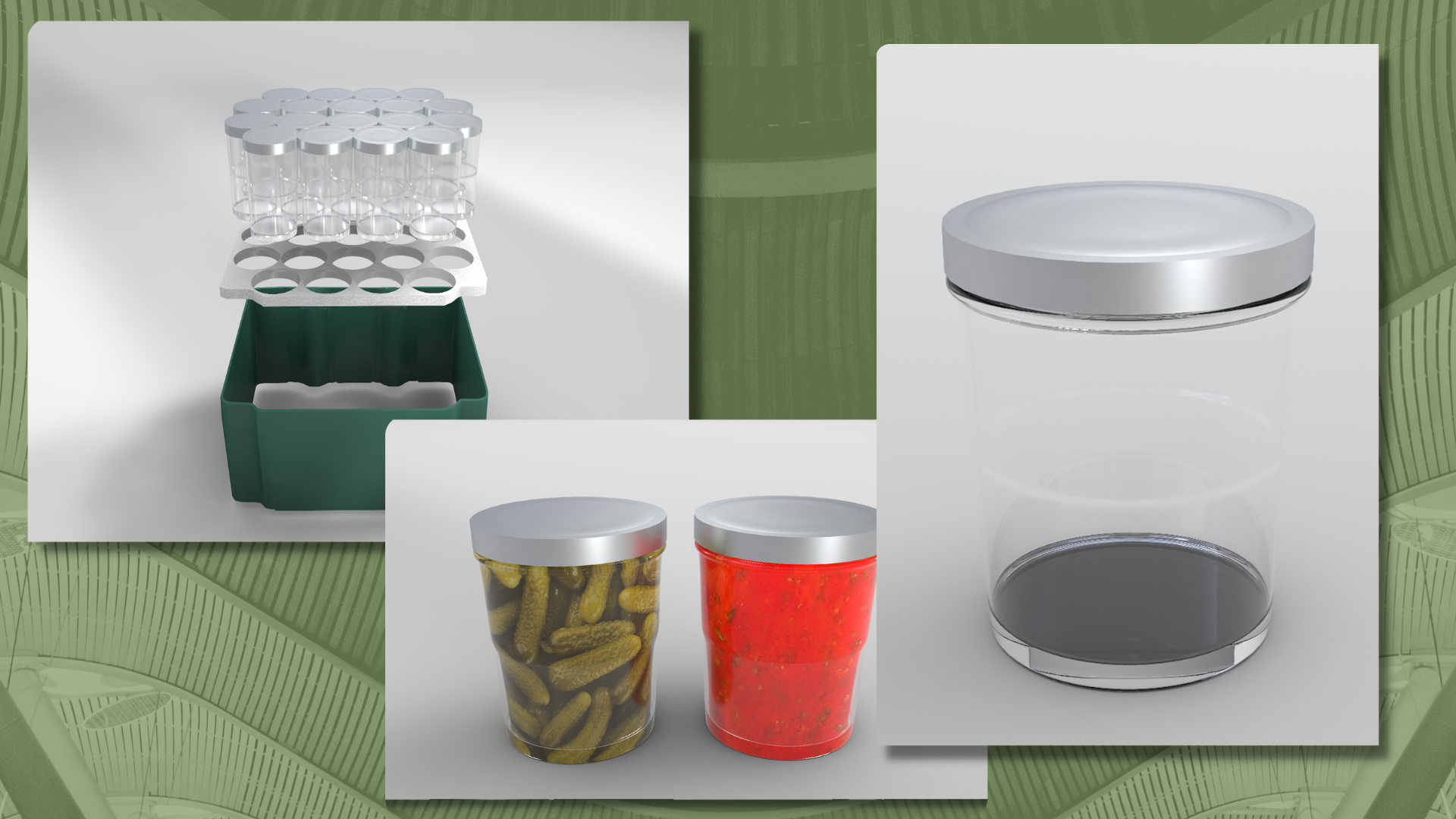
It is always the details that determine whether packaging is suitable for reusable use or not. What do you think is the most complicated part of a standard shampoo bottle? It is the only mechanical part of such packaging, namely the pump head. Firstly, it is comparatively difficult to dismantle and secondly, it consists of a simple mechanism that is often a hindrance to reusable use and often also contains metal. So how can shampoo bottles be turned into reusable packaging? Quite simply - or not so simply: instead of pump heads, standardised alternatives are used for refillable cosmetics packaging. Although European cosmetics manufacturers have also long since committed to reducing packaging volumes accordingly, Japan in particular is already much further ahead with the reusable concept: 80 per cent of shampoo packaging there has been converted so that it can be refilled directly at the POS.
Refillable packaging as an economic factor
The example shows: If you want reusable packaging, firstly you have to think about the reusable purpose right from the packaging technology stage and secondly you have to create an accepted infrastructure, as Japanese cosmetics companies have consistently done and introduced their consumers to the refill idea. In Japan - by the way - a remarkable market has also emerged in this circular economy: according to information from the Japanese Ministry of Economy, the refill market in Japan has an annual volume of around 2.5 billion euros. "Many refill stations are already being trialled in Europe too, including in the cosmetics sector. I think the acceptance is of course also due to the selection of products. The less variety there is, the more people turn to disposable packaging to get 'their' product," says Pacoon Managing Director Peter Désilets.
The role of the catering trade in reusable systems
In Europe, however, a start could be made on popularising the reusable idea in another market: food, for example. This is where the consumer naturally has many points of contact and also pain points when dealing with packaging. After all, reusable packaging has been mandatory for the catering industry since 2023, which - despite some exceptions and loopholes - would be suitable for anchoring the topic in consumers' minds, at least psychologically. Now that coronavirus in particular has made food deliveries to the home or office a matter of course, there would be a corresponding lever here. As you can see, we are writing in the subjunctive. Because at least in 2022, i.e. before the reusable offer obligation came into force, the proportion of reusable options used was almost below the perception threshold. Only 0.1 per cent of food and just four per cent of drinks were consumed in reusable containers. That's a shame, because pizza boxes, sauce tins and to-go boxes make up 80 per cent of the volume of packaging used in restaurants. "The reusable to-go offer is still in its infancy. However, there is a clear legal trend towards forcing the issue of reusable packaging: The ban on disposable packaging for consumption on site is one example. Taking back packaging must also become much more convenient for consumers. Of course, there are also hygiene aspects associated with returns, both at the point of return and during cleaning. This is not trivial and the take-back points would also have to provide cleaning facilities - which many snack bars do not have. That's why take-back has to be reorganised," says Peter Désilets, explaining the hurdles.
Reusable in the B2B sector: underestimated and innovative
Another testing ground for reusable packaging could be industrial logistics - and there we find a perhaps unexpected ally: electromobility. The demand for lithium-ion batteries in Germany is set to rise to around 2,000 gigawatt hours by 2030 - a tenfold increase on current demand. And these batteries, which are fragile, bulky and heavy, also need to be transported safely. Some manufacturers are now offering reusable constructive packaging (CIPs) to meet this demand. The technological hurdles are somewhat high: the batteries are categorised as hazardous goods, so the containers also require high safety standards. However, there is also a lot of charm in such specialised niches, as they create pressure to innovate in the packaging sector.
"In other industries, too, reusable packaging has long been used in B2B. Many OEM parts are delivered in reusable containers, pharmacies receive their deliveries in reusable boxes, fruit, vegetables, meat and fish often come in reusable crates and pallets are kept in pools. That's why there are organisations like ENFIT that take care of regulated cycles and traceability so that standards are set," says Désilets.
A reusable system that grows with you
With its CYRCOL reusable concept, Pacoon has chosen a comprehensive approach that is also characterised by a high level of convenience in favour of consumers and consideration of the needs of retailers when expanding the infrastructure. For example, the concept relies on PaaS (Product as a Service), rental containers, regional, independent cleaning stations and an optimised collection system instead of today's proprietary systems. These are currently being developed in cooperation with many national and international networks, such as the reusable drinks association or drinks pools.
The aim is to create a system that is both convenient for consumers and easy to integrate into retailers' circular economy systems. Such a reusable system must have a modular structure and respond flexibly to the market. The decoupling of reusable containers and brand ownership will also give a major boost to the use and availability of reusable products. The purchase of containers, the cleaning systems and the battle for the last few per cent of purchased but standardised containers has been an obstacle to expansion to date.
There are also plans to neutralise the containers in the cleaning step. This means that branding can be applied and the containers do not have to be transported back to the brand owner after cleaning, but can remain in the region. This will significantly reduce sorting and transport costs. In recent years, many brand owners have recognised that only the least brands manage to achieve recognition through the packaging form. In return, the idea of sustainability is given a clear cost advantage through harmonisation. This should also help to reduce the scepticism of brands towards reusable systems for branding reasons. Because we know that packaging is also a strong brand signal. Peter Désilets on the advantages of Pacoon's reusable system: "Our reusable concept takes into account several points that were previously not optimal: starting with a system that is not only stackable - like all previous reusable containers - but also nestable when empty. We achieve this through a special crate system with tray and container that can be nested in themselves. The simple shape also makes it easy to fill and clean. Modular crate frames in combination with modular trays also allow a variety of packaging units per crate depending on the container format. Many other aspects are already being considered that clearly differentiate the concept from existing containers."
👉 Our next webinar: More ways to reuse
How can you eliminate the disadvantages of today's reusable systems and containers? We have the answers to these and many of your questions about reusable systems for you at our next webinar on 20 February! Become a part of it!